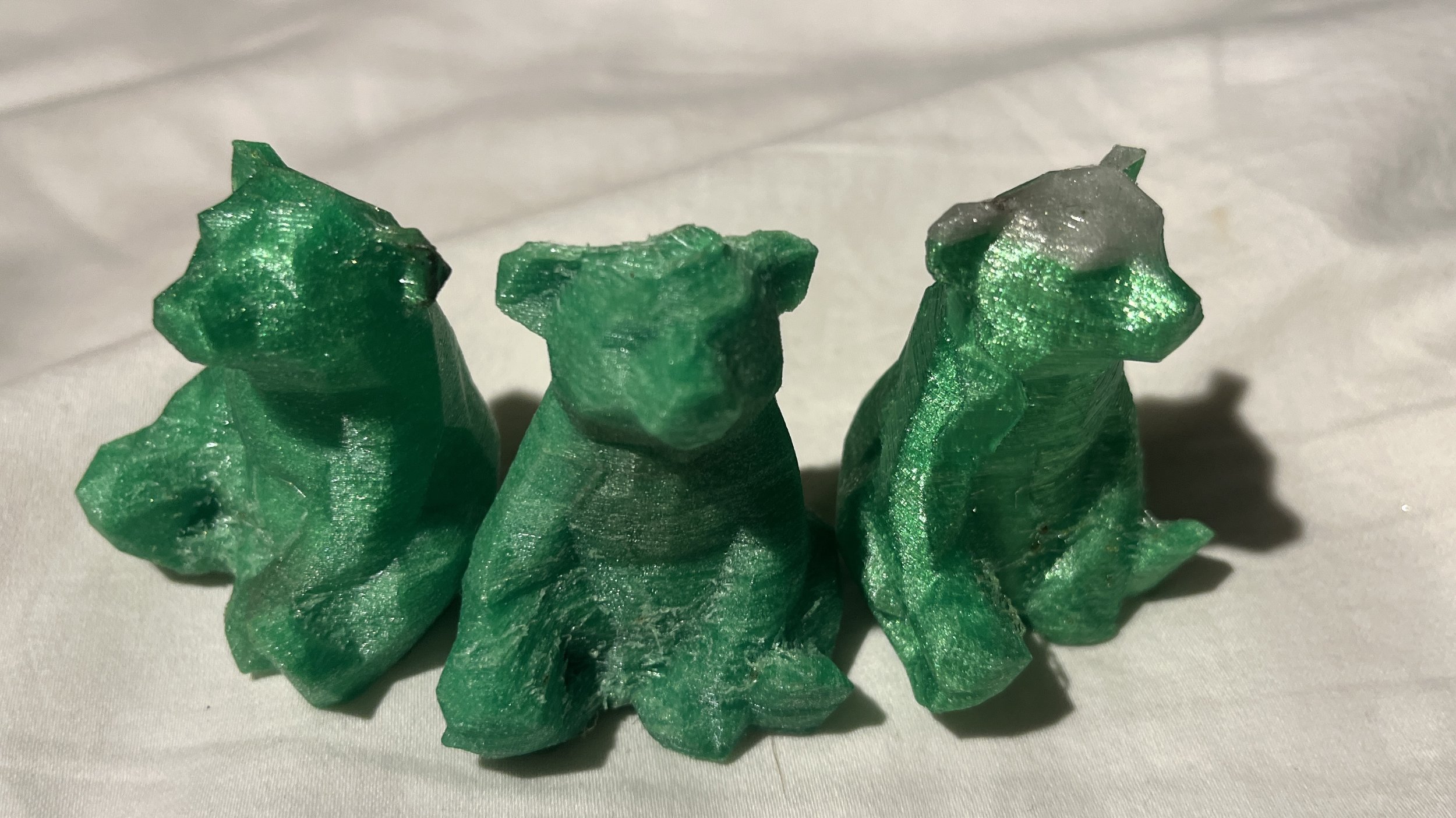
Filabottle: Plastic Bottle to 3D Printable Filament
ME102B: Mechatronic Design Mechanical Engineering Capstone Design Innovation Award

Finalized Concept at Capstone Showcase
Background and Context
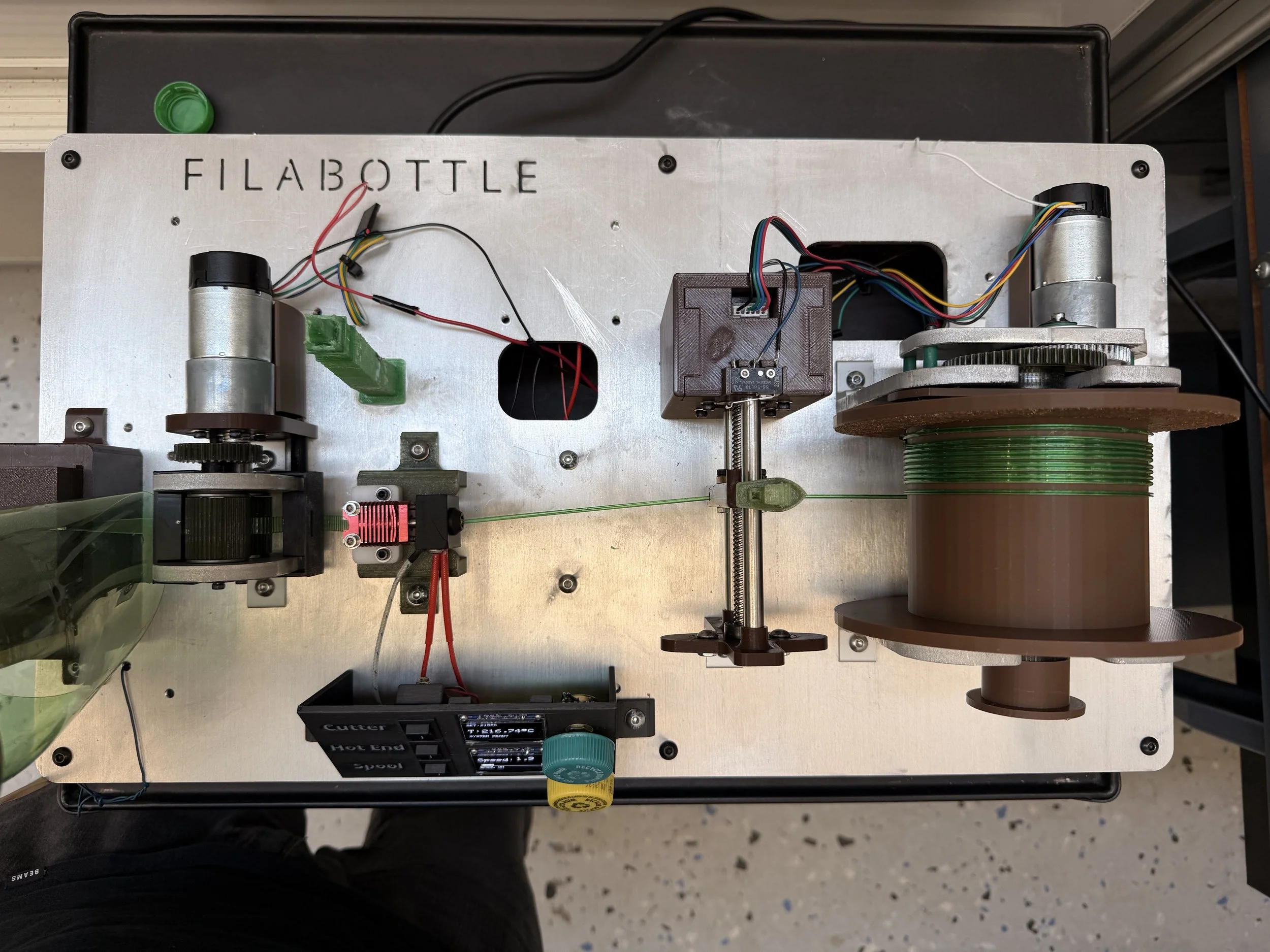
Filabottle is an automated system that cuts, extrudes, and spools PET bottles into 3D-printer filament.
Filabottle targets home and hobbyist 3D-printer owners who want to cut filament costs and reduce plastic waste. Commercial filament is typically more expensive, while the raw material (used 2L bottles) is free and diverted from landfill, giving makers a low-cost, closed-loop way to source filament from waste they already generate.
Core Objectives and Goals
Our core objective was to build a working end-to-end pipeline that could take a pre-processed plastic strip and turn it into usable 3D-printer filament, live, in front of an audience.
Concretely, that meant three subsystems had to work reliably together:
1) A cutter that sliced continuous strips from prepped bottles,
2) A hot-end extruder that melted and reformed those strips into filament,
3) A spool-driven pulling and winding system that pulled filament through the extruder and distributed it evenly onto a spool through a linear actuator.
Stretch goals initially included fully automating the bottle preprocessing step (currently done by hand), combining multiple strips or filament runs into larger spools, and expanding the system to handle plastics beyond PET. Scoping the project this way let us prioritize the function-critical path early and gave us a clear, demonstrable system by the final showcase.
Initial Design + System Overview


Cutting
At the cutting stage, a DC motor drives a blade to slice a prepped bottle into a continuous plastic strip.
Extrusion
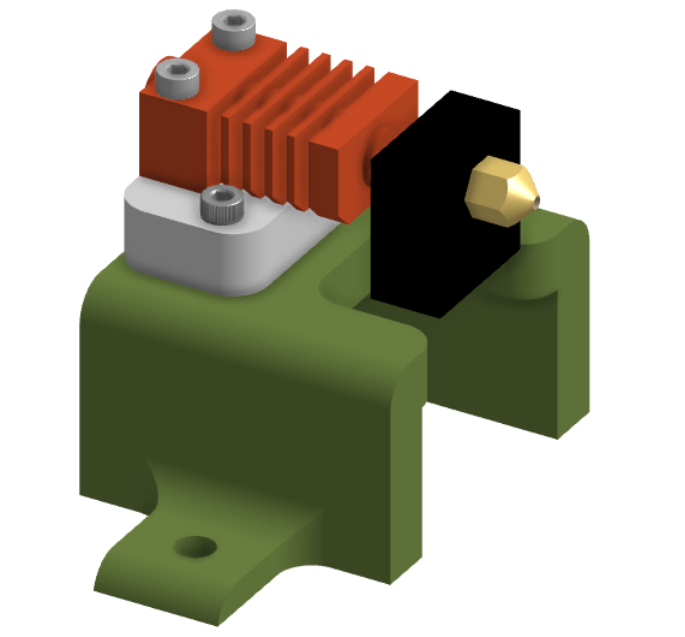
The strip is fed through a heated extruder nozzle, which melts and reforms it into cylindrical filament. A thermocouple-based temperature sensor holds the nozzle at a constant target temperature to keep the extrusion consistent. A second heating element, paired with its own thermocouple, was planned to weld the ends of filament strands from separate bottles together. This is so the final spool wouldn't be capped at the yield of a single 2L bottle.
Quality Control
Before winding, the filament passes a laser micrometer that checks its diameter against a 1.75mm target in real time. This defines explicit accept/reject criteria: oversized filament gets a second pass through the nozzle, undersized filament is scrapped.
Winding & Spooling
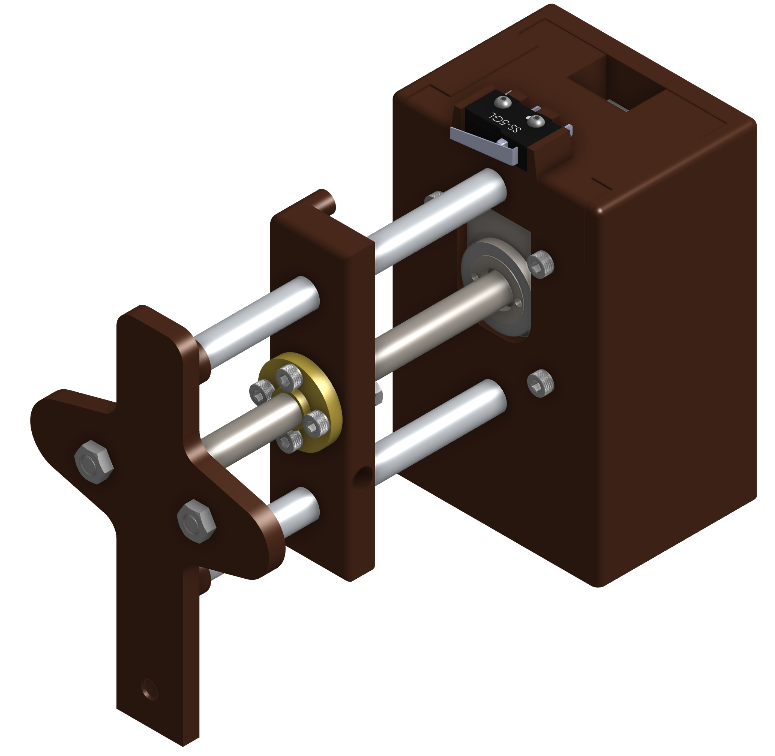
A second DC motor drives a gearbox transmission that rotates the spool, while a linear guide moves back and forth to distribute filament evenly across the spool width.
Controls & Electronics
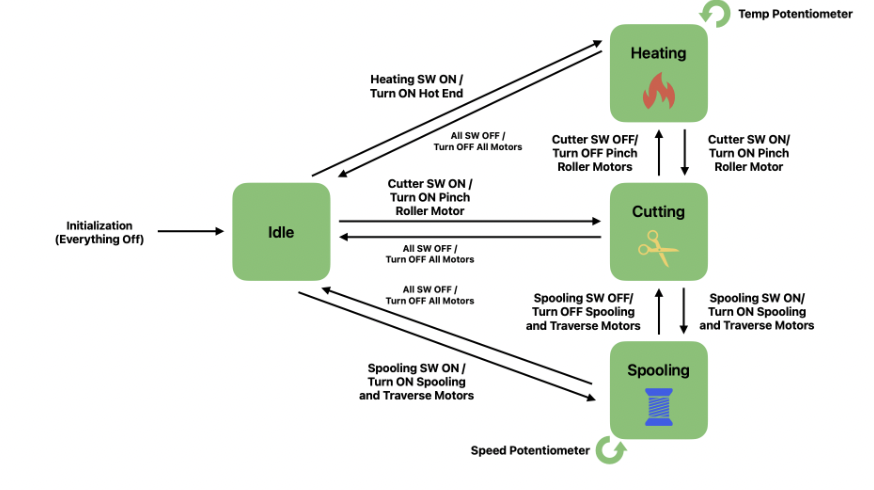
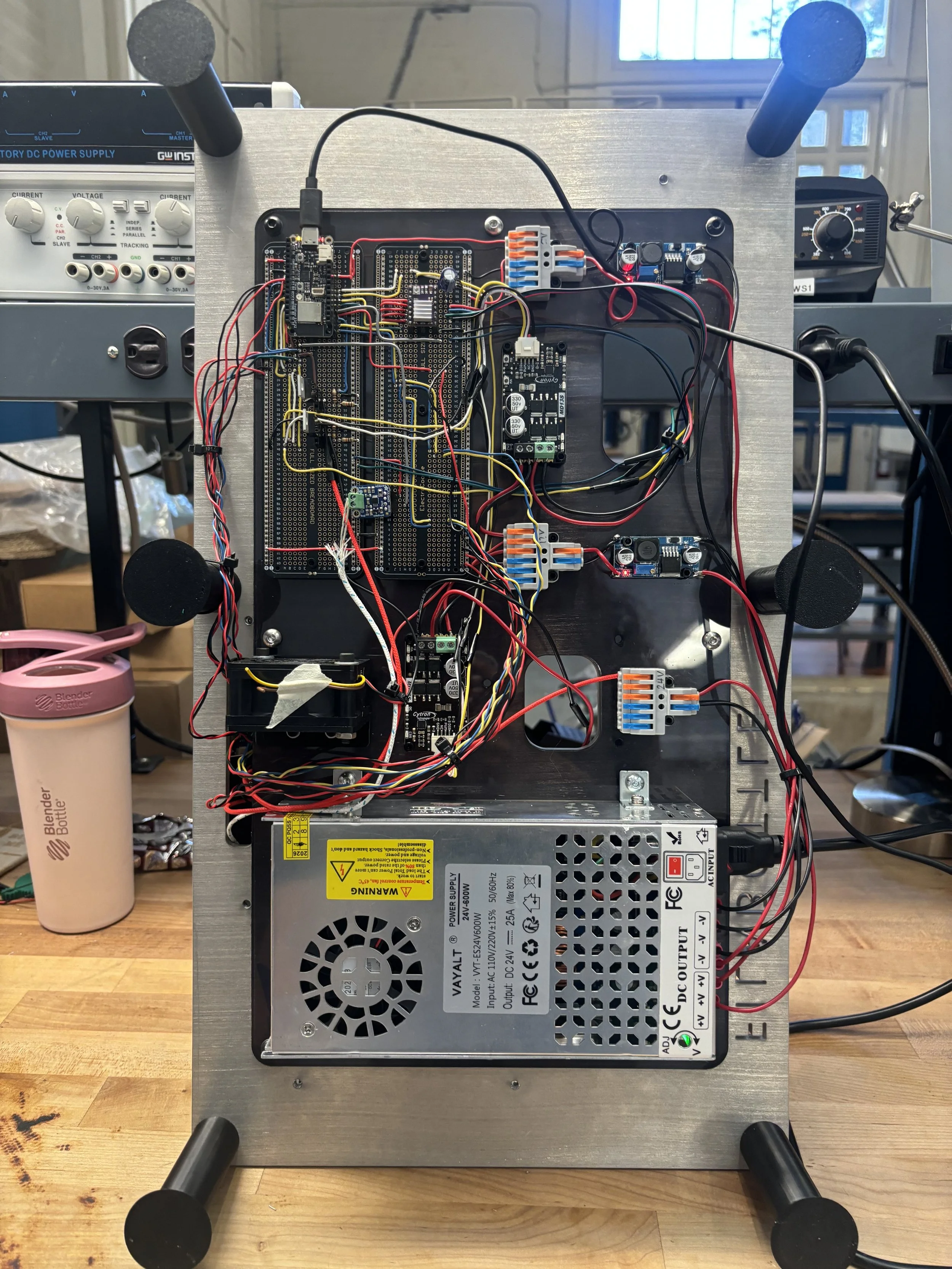
An ESP32 controls both the DC motors and the heating elements. A digital input panel lets the user start, stop, speed up, or slow down the spooling process, and an OLED display gives live feedback, which gives the user visibility and control over the process without needing to interact with the electronics directly.


Our first CAD iteration included a pinch roller system positioned to pull filament out of the extruder, paired with a chain drive transmission that kept the pinch rollers and spool rotating at the same RPM. This was largely inspired by similar mechanisms we'd seen in other filament-recycling projects online. As we refined the design, we found the chain drive couldn't deliver enough torque for the system, and realized the pinch rollers didn't actually need to be positioned/driven in sync with the spool at all. Removing that constraint let us simplify the drivetrain, moving toward the gearbox-based transmission in the final design.
Similarly, the bearing shear cutter required tighter machining precision than we could reliably achieve, so we replaced it with a simpler fixed razor-blade cutter.
Design Refinement and Iterations
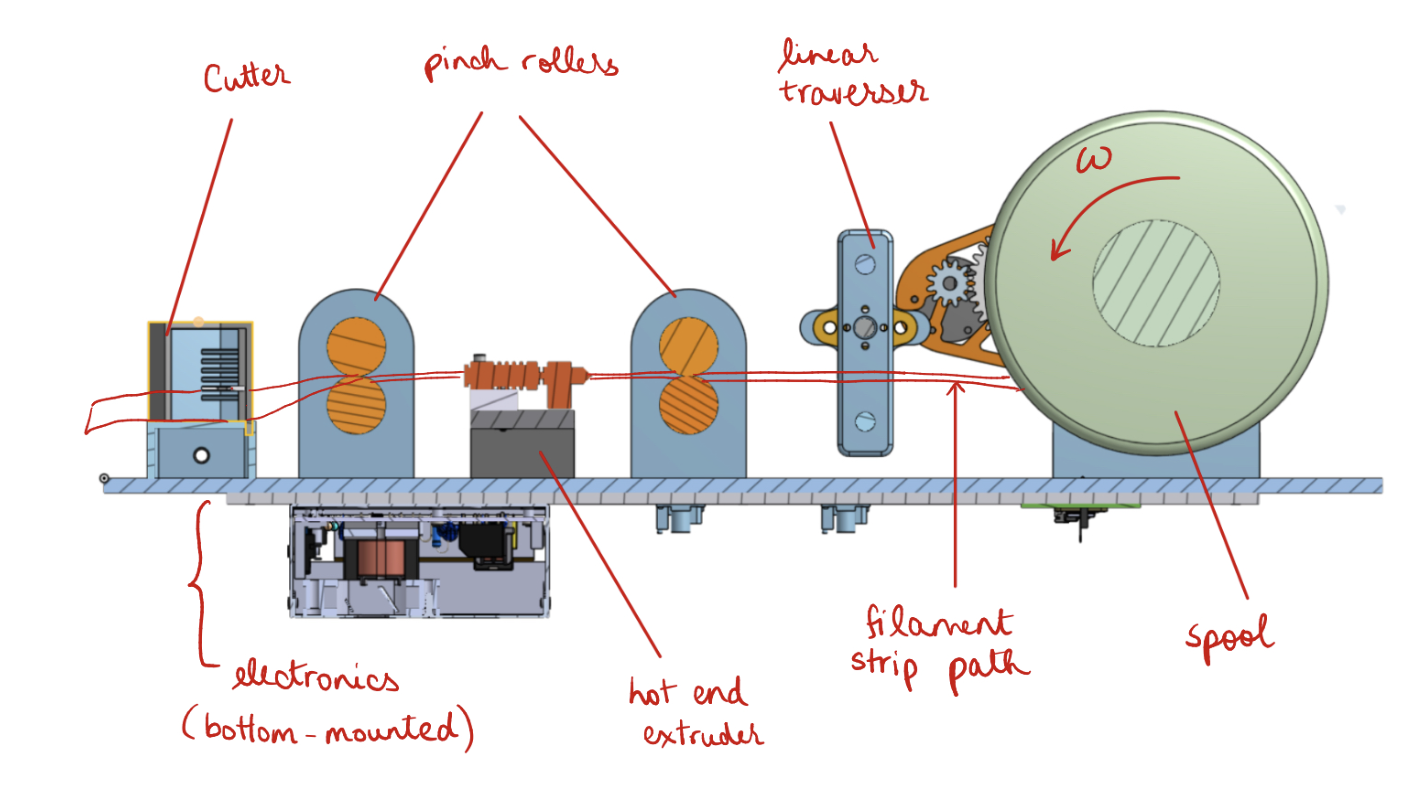

As we refined the design, several of these choices didn't hold up under real loads. The pinch roller system evolved into two rollers: an active roller to help pull the plastic strip through the cutter, providing additional torque, and a passive roller meant to guide filament into the linear actuator. However, the passive roller ended up adding extra torque load onto the spool that it couldn't handle, so we removed it and kept only the active roller.
The drop-in spool design ran into a similar problem: the high loads on the spool axle made a quick-release mounting impractical, so we shifted to a more secured, fixed-mount spool. This was a big tradeoff, as a drop in spool was a more novel design.
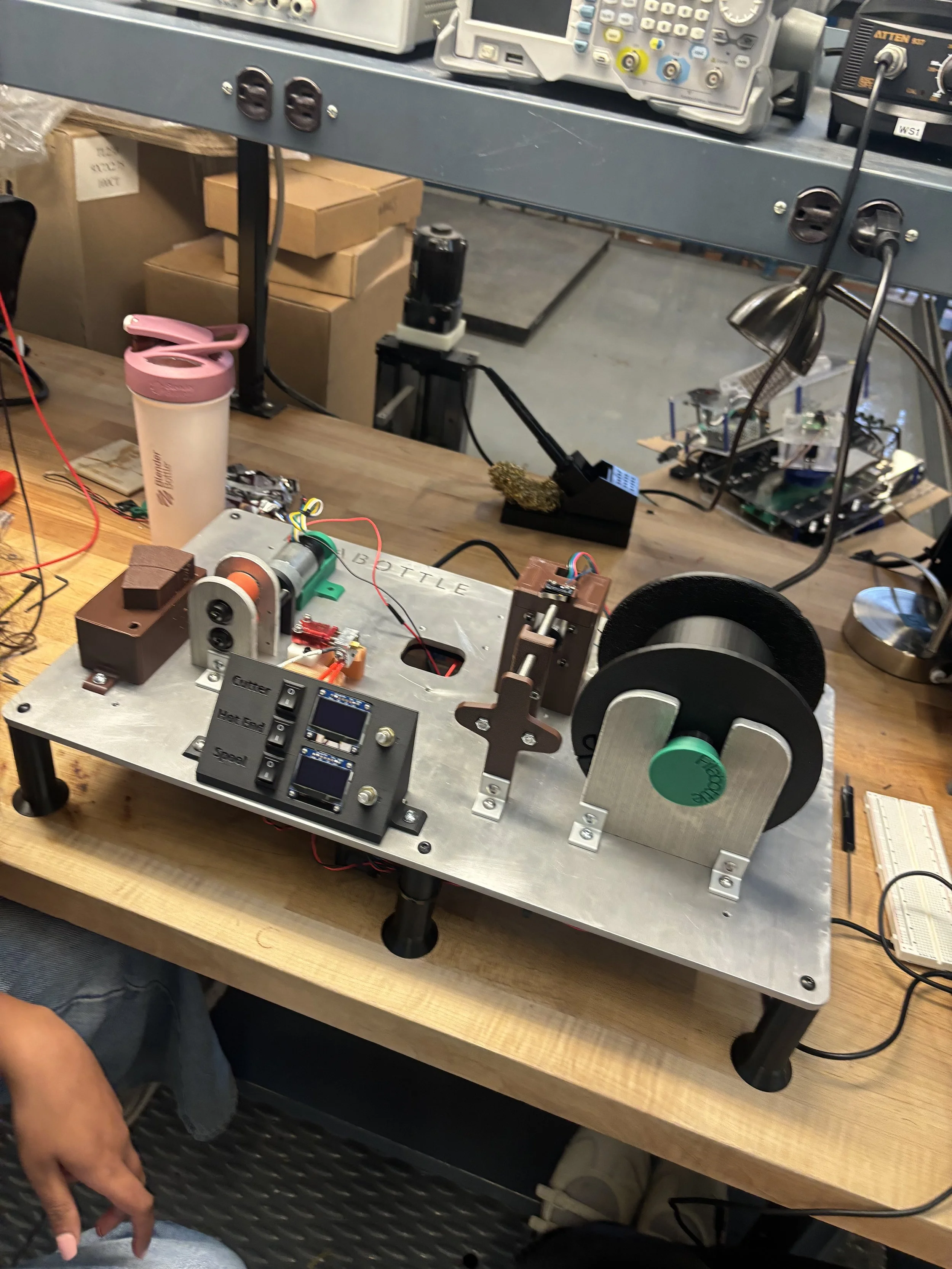
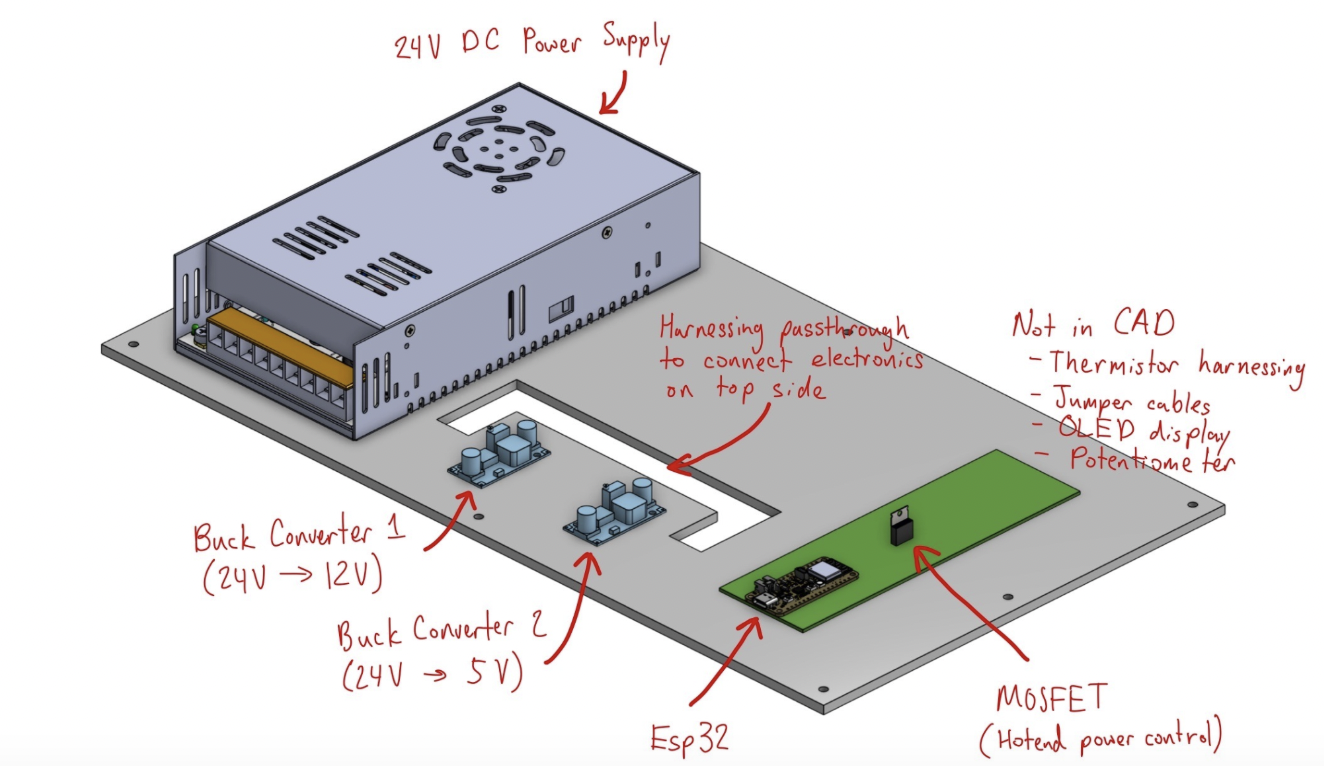
On the controls side, our initial design included a laser micrometer for automated filament diameter quality control, but we ultimately removed it in favor of a simpler, more direct interface: potentiometers for the user to manually control hot-end temperature and spool speed, paired with OLED displays showing live feedback for each. This traded automated quality checking for a more manageable, user-driven control scheme that was easier to implement and tune reliably within our timeline.
Initial Runs + More Design Changes
Additionally, we created a guide for the cut plastic strip into the active pinch roller. In terms of control and code, we were pushing changes to ensure that the linear actuator was evenly spacing the filament out on the spool as this mechanism was coupled with the potentiometer (this is in addition to working through any bugs).
All stands and the mounting plate were made from waterjet aluminum.
In the current iteration, we were unable to automatically cut the plastic bottle as the we were directly driving the pinch rollers with the 12V DC, which still was not enough torque. As such we created a gearbox (3:1 ratio) in order to increase the pulling force. Additionally, instead of using soft, silicone rollers, we 3D printed rollers with grooves to help and grab onto the plastic.
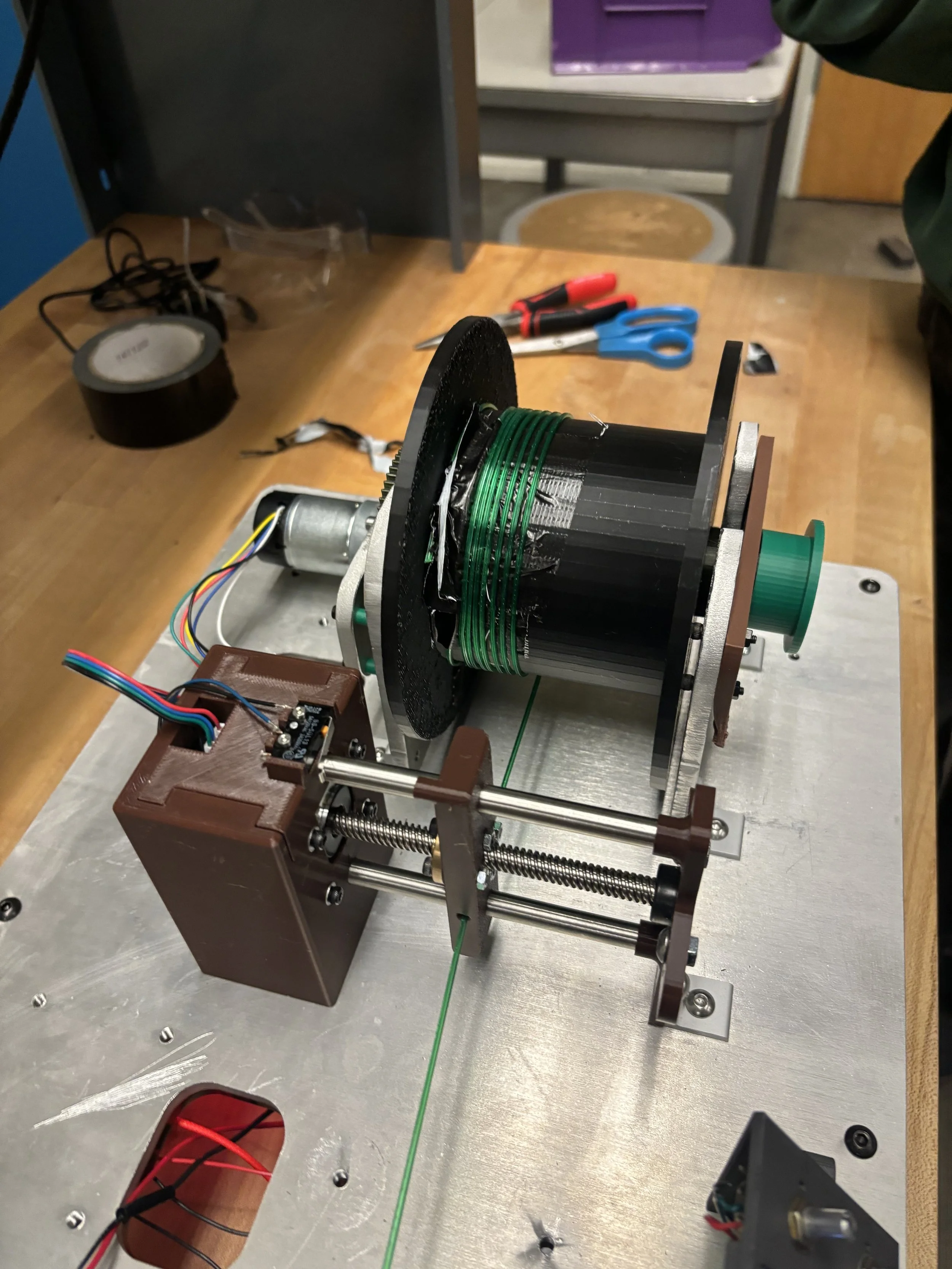
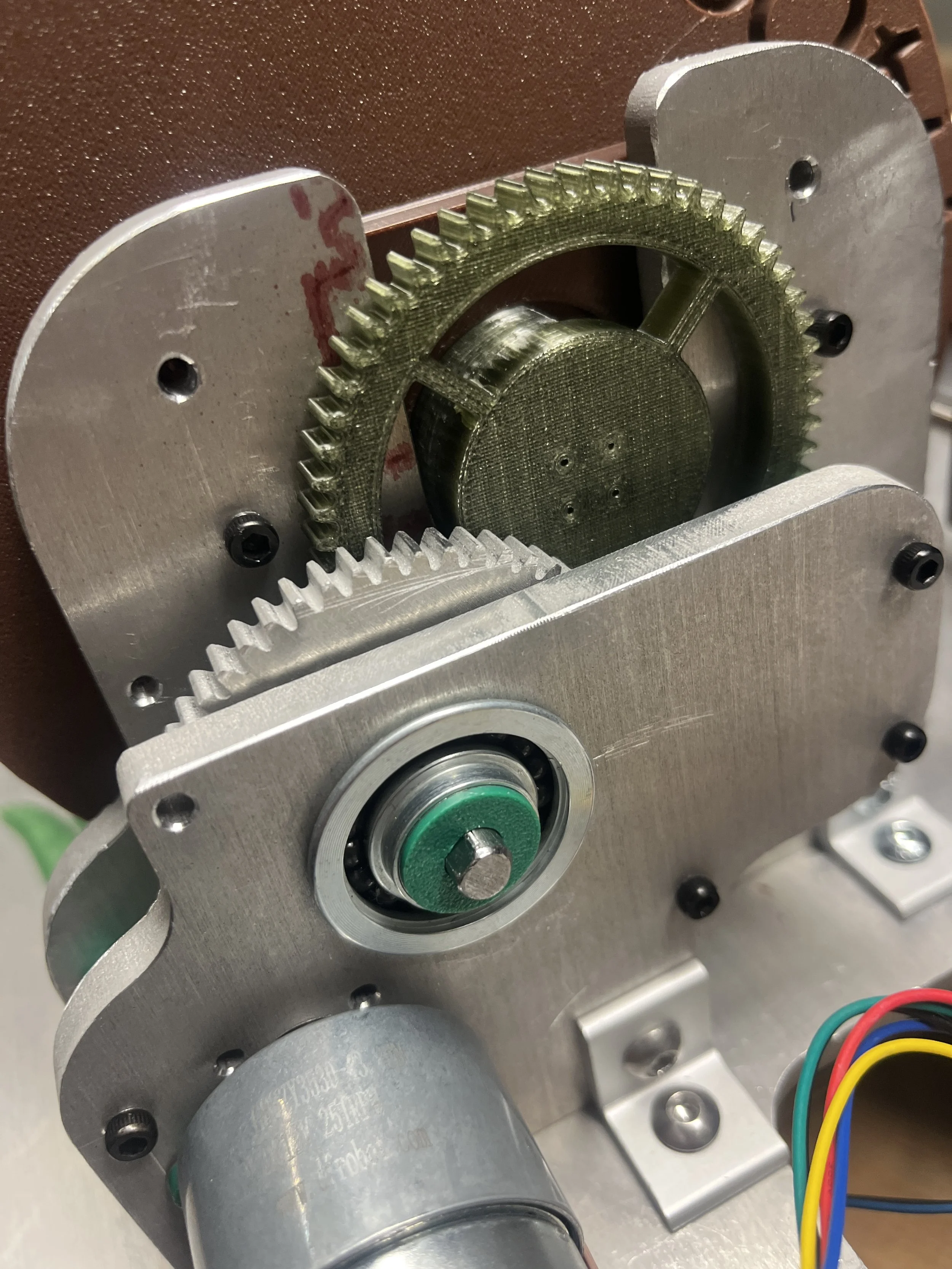
We revised the spool gearbox after running into a durability issue: the original design used a two-stage 3D-printed gearbox with an 11.25:1 ratio, but under load the plastic gear and D-shaft interface began shearing, and the gearbox couldn't generate enough torque to reliably pull filament through the extruder. To fix this, we switched to gears cut from waterjet aluminum and increased the overall ratio to 22.5:1, which held up under the required loads and gave us consistent filament pulling and spooling.
Finalized Design and Functional Prototype




Future Iterations and Key Insights
Key Insights
The clearest lesson across this project was that torque and load requirements are easy to underestimate on paper theoretically: nearly every major redesign (the chain drive, the plastic spool gears, the passive pinch roller) came from a mechanism that looked sound in CAD but failed once real filament tension and friction were introduced. Related to that, we often went with simpler designs to prioritize functionality: the fixed razor blade beat the bearing shear cutter, and the single active pinch roller beat the two-roller system, both because they demanded less precision and fewer failure points to hit the same function. We also learned to distinguish between complexity that adds real value and complexity that doesn't. The laser micrometer and drop-in spool were both reasonable ideas that we ultimately traded for simpler, more robust alternatives (manual pot control, fixed-mount spool) once we weighed the engineering cost against what they actually bought us. Finally, prioritizing the hot-end extruder early on, the most function-critical, highest-risk component, meant that when later redesigns were needed elsewhere, we had a stable core to build around rather than being blocked everywhere at once.
Future Iterations
With more time, the most valuable next step would be automating bottle preprocessing (cleaning, drying, removing the cap and label), which stayed a manual, human-in-the-loop step throughout. This closes the gap and would make the system genuinely hands-off rather than semi-automated. Reintroducing filament quality control would also be worth revisiting, but with a more robust implementation than the original laser micrometer. This could mean potentially feeding diameter data back into extruder or pulling speed automatically rather than relying on user judgment. On the mechanical side, redesigning the spool mount to allow quick, secure spool changes without sacrificing the load capacity we needed would solve the problem the original drop-in design couldn't. Longer-term, expanding beyond PET bottles to other plastic types, and combining filament from multiple bottles into continuous, larger spools, would move the system from a single-bottle demo toward genuinely practical, everyday use.